
Is Fluorocarbon Line Invisible to Carp?
Fluorocarbon line is often sold as "invisible underwater". It isn't. But there is real physics behind why it's harder to see than nylon, and the numbers are worth knowing before you pay for it.

Why clear things show up underwater
You see a clear object because light changes when it crosses from one material into another. Some of it bends (refraction) and some of it bounces back (reflection). Those bounces and bends at the edges of a line are what give it away.

Refractive index
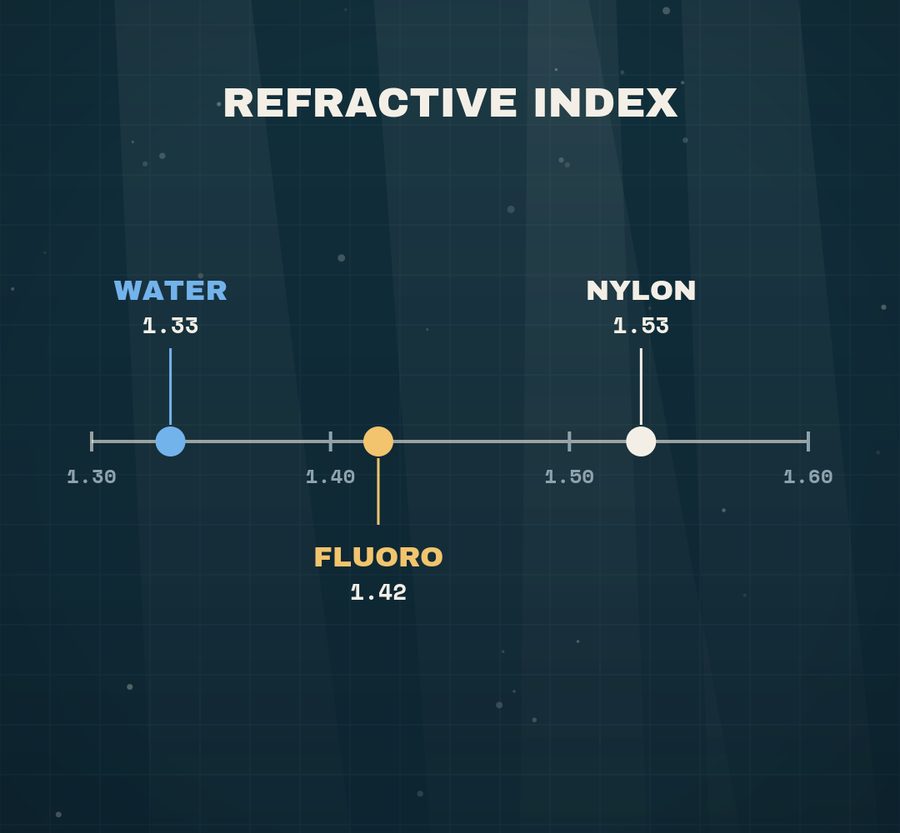
How strongly a material bends and reflects light is set by its refractive index. The closer a line's index is to water's, the less light it reflects and the less it stands out.
- Water: about 1.33
- Nylon: about 1.53
- Fluorocarbon (PVDF): about 1.42
Exact values vary a little from product to product, but fluorocarbon sits much closer to water than nylon does.
Four to five times less reflection
The amount of light reflected at a boundary depends on the mismatch between the two indices (the Fresnel equations). For light hitting the line head-on, nylon reflects about 0.47% of it. Fluorocarbon reflects about 0.10%. That's roughly 4–5 times less.
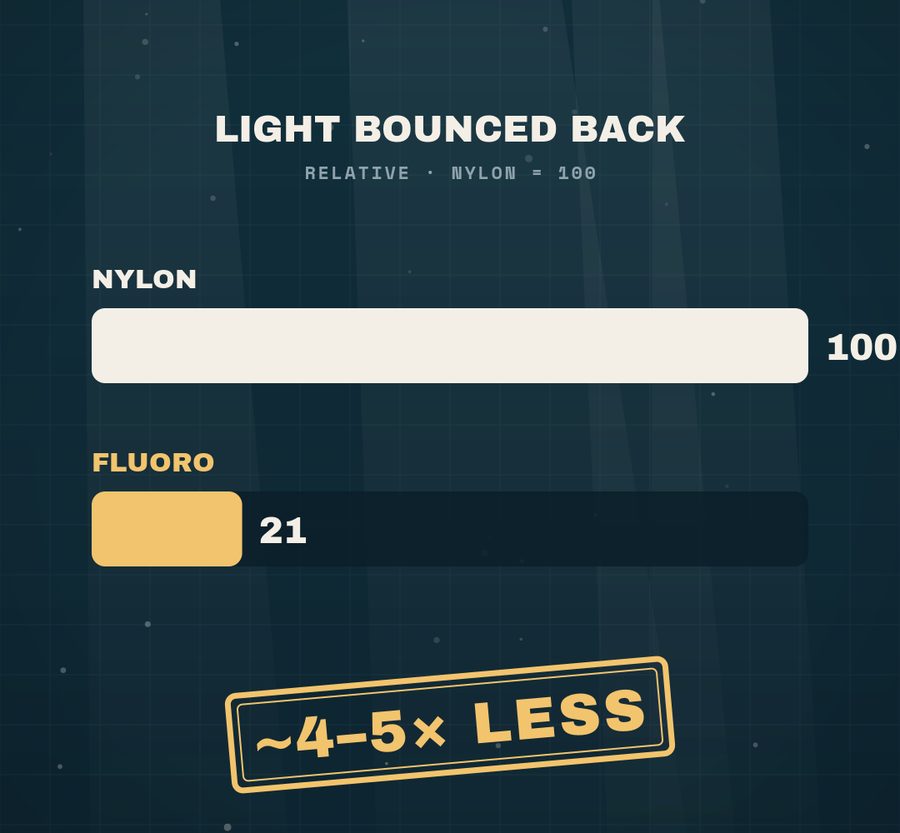
That's the physics for a clean, ideal surface. In the real world, how visible a line is also depends on its diameter, colour, the light, the angle, scuffs and wear, and the fish's own eyesight.
It sinks faster too
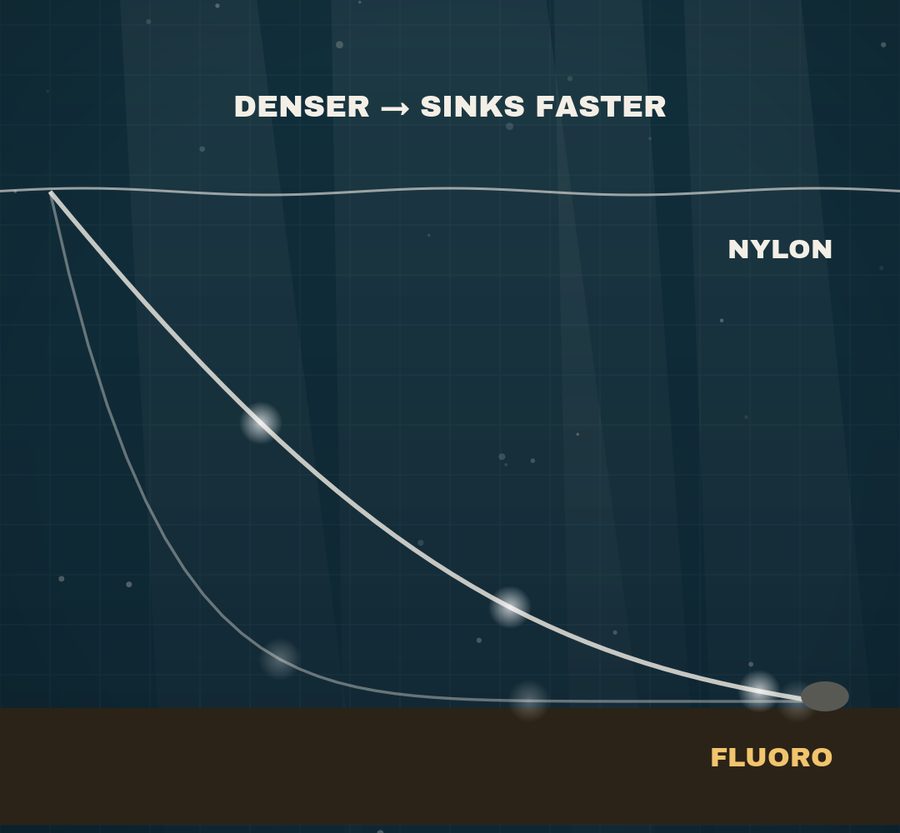
Fluorocarbon is also much denser than nylon: about 1.78 g/cm³ against about 1.14. Both are denser than water, but fluorocarbon sinks much faster and tends to lie flatter on the bottom, which matters near the rig.
The verdict
Invisible? No. Closer to invisible than nylon? Yes, measurably.

Where this comes from
Refractive index: water ≈ 1.333, nylon (polyamide) ≈ 1.53, fluorocarbon (PVDF) ≈ 1.42
Standard polymer optical data (e.g. polymer handbooks and refractive-index databases); manufacturers quote ~1.42 for PVDF lines
Reflection at a boundary grows with the index mismatch (Fresnel)
Basic optics
~4–5× less light reflected than nylon
Fresnel at normal incidence: nylon ≈ 0.47%, fluoro ≈ 0.10% (ratio 4.3–5.2 for nylon 1.52–1.54)
Fluorocarbon is much denser than nylon (~1.78 vs ~1.14 g/cm³), so it sinks faster
Material data (PVDF vs polyamide 6)
"Lies flatter on the bottom"
Follows from density and stiffness. A dramatisation of typical behaviour.
"Not invisible"
Follows from the above (the index is closer, not equal)