
Carp can barely hear you talking. But they can hear you walking.
Anglers whisper on the bank and then stomp down to the water's edge. Physics says that's exactly backwards. Your voice barely reaches a carp, but your footsteps travel straight to it.
Why your voice bounces off
Sound in air struggles to get into water. The two have very different acoustic impedance, a measure of how hard it is to push a sound wave through a material. At that mismatch, about 99.9% of the sound energy reflects off the surface and only around 0.1% gets in. That's a drop of roughly 30 decibels.
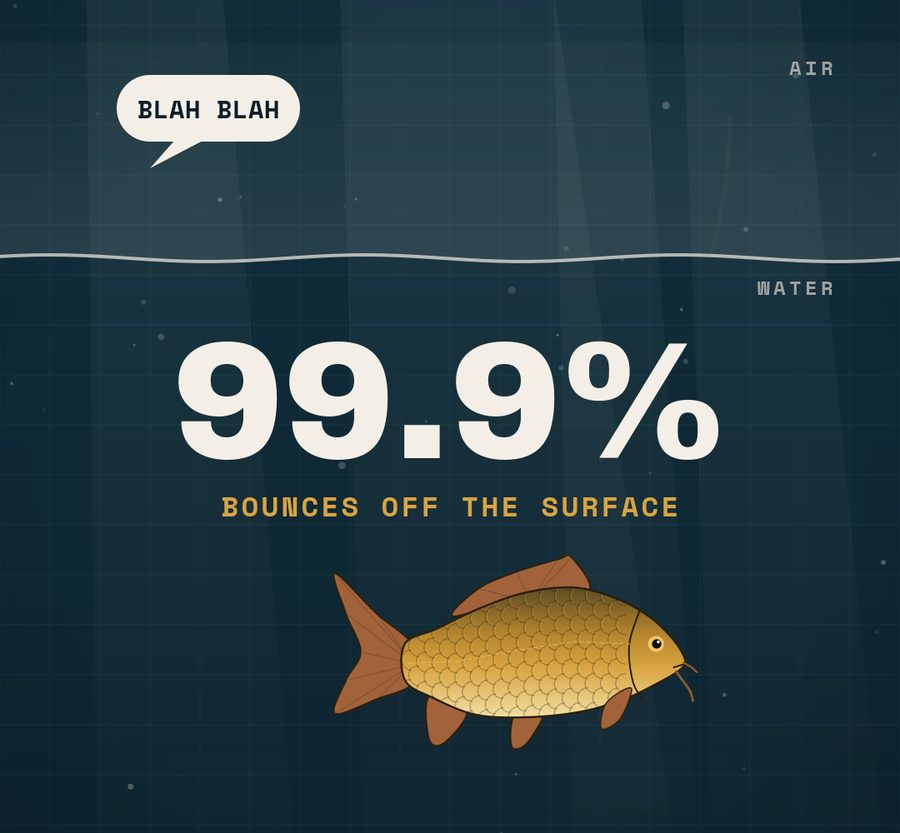
That's why we say carp can barely hear you talking, not that they can't. Something very loud can still get through. Normal conversation on the bank is a whisper by the time it's underwater.
Why your footsteps don't
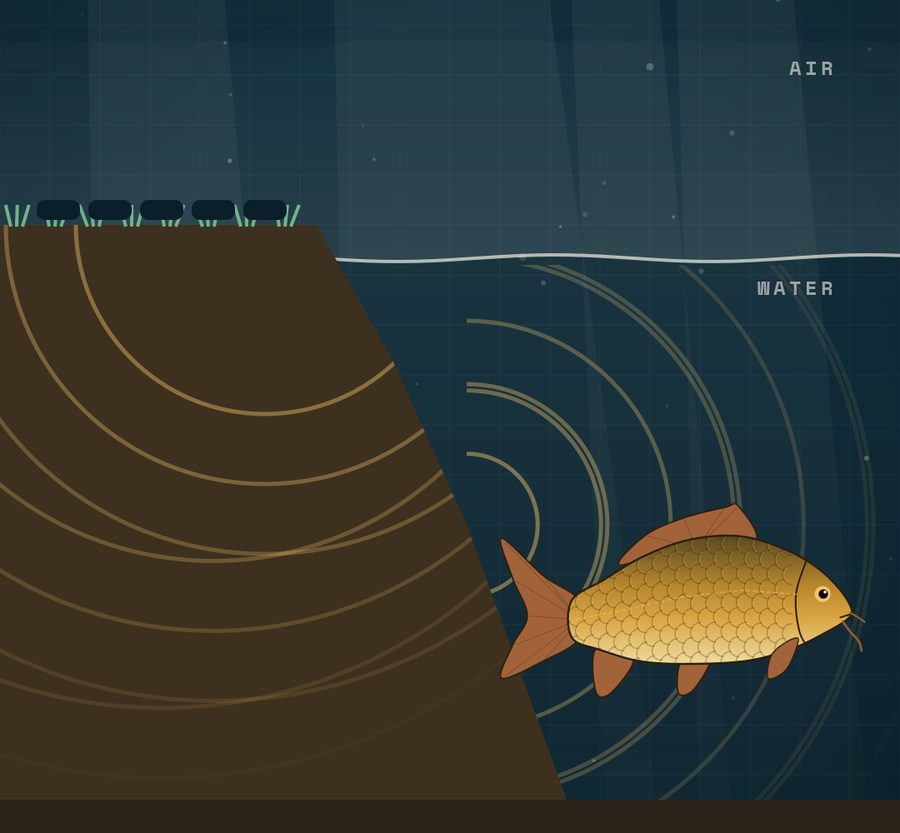
A footstep doesn't need to cross the air–water boundary. The vibration goes into the ground, and the ground is in direct contact with the lakebed and the water. How much gets through depends on the bank: hard clay carries it better than soft peat. Either way, it skips the barrier that stops your voice.
A hearing aid made from the spine
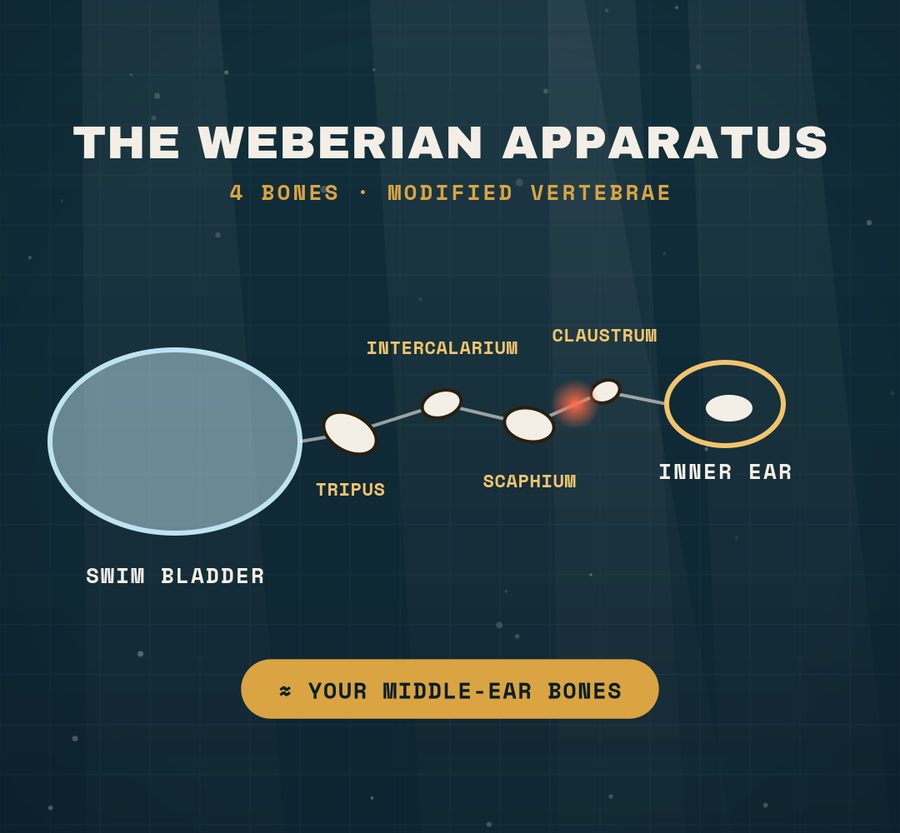
Carp are unusually good listeners for a fish. They have a Weberian apparatus: a set of modified vertebrae forming four tiny bones (the tripus, intercalarium, scaphium and claustrum) that link the swim bladder to the inner ear. The gas-filled bladder vibrates with sound and the bones pass it on, a lot like the bones in your own middle ear. They evolved separately, but they do a similar job.
How much difference it makes
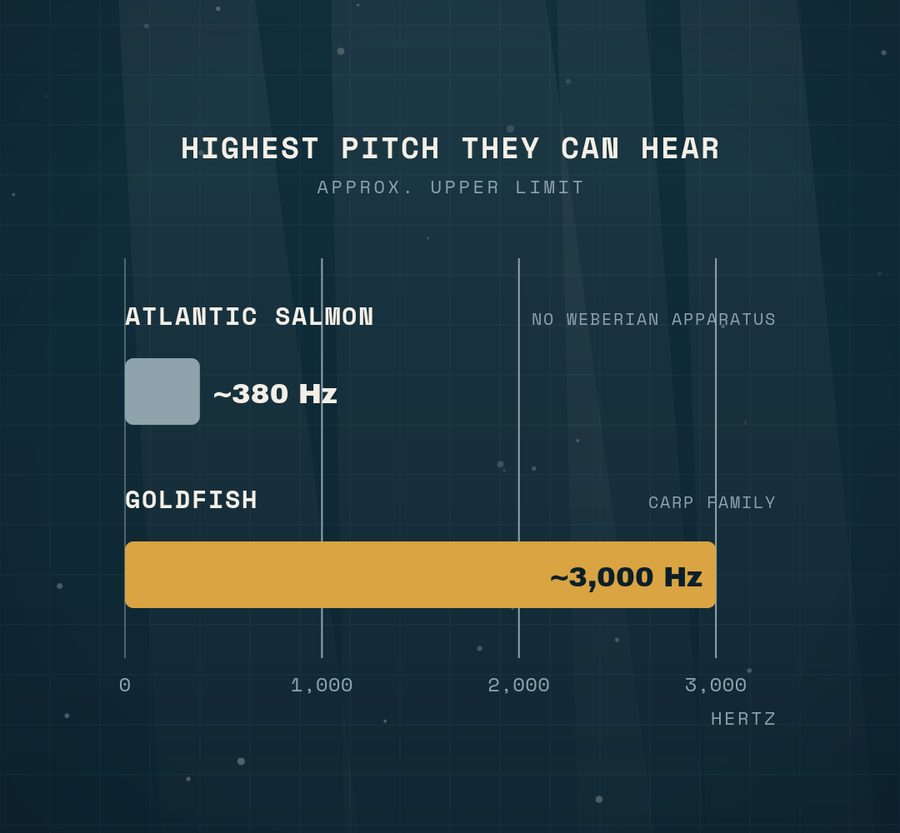
Compare a fish without this system to one with it. Atlantic salmon hear up to about 380 Hz. Goldfish, close cousins of carp in the same family, hear up to around 3,000 Hz, and some studies show responses even higher. That's about eight times the range.
How we know: the sources
Every claim in the video, where it comes from, and how sure we are.
-
~99.9% of airborne sound energy is reflected at an air–water boundary (only ~0.1% transmits, ≈ −30 dB)
SOURCE Basic acoustics: the acoustic impedance mismatch between air (~415 rayl) and water (~1.5 M rayl)
CONFIDENCE High (physics)
-
"Carp can barely hear you talking"
SOURCE Follows from the above. Very loud noise can still get in, which is why we say "barely", not "can't".
CONFIDENCE Phrased carefully
-
Footsteps travel through the substrate and into the water
SOURCE Ground-borne vibration couples straight into the water and lakebed, without crossing the air–water boundary
CONFIDENCE High (physics). The amount depends on the bank (hard clay vs soft peat).
-
Carp bolting at footsteps
SOURCE A dramatisation of commonly observed angler experience
CONFIDENCE Illustrative
-
The Weberian apparatus is made of modified anterior vertebrae; four ossicles (tripus, intercalarium, scaphium, claustrum) link the swim bladder to the inner ear
SOURCE Standard ichthyology, e.g. Helfman et al., The Diversity of Fishes (2009); Bird & Hernandez (2007) J. Morphology
CONFIDENCE High
-
Analogy to mammalian middle-ear bones
SOURCE A common teaching analogy. The function is similar, though the bones evolved independently.
CONFIDENCE Fair analogy
-
Atlantic salmon upper hearing limit ≈ 380 Hz
SOURCE Hawkins & Johnstone (1978), The hearing of the Atlantic salmon, J. Fish Biology 13: 655–673
CONFIDENCE High.
-
Goldfish hear up to ~3,000 Hz (some studies show responses to ~4 kHz)
SOURCE Fay (1988), Hearing in Vertebrates: A Psychophysics Databook
CONFIDENCE High. We say "around 3,000".
-
Goldfish are close relatives of carp
SOURCE Both are Cyprinidae (Carassius auratus and Cyprinus carpio)
CONFIDENCE High